Ternary-Bonsai-2-27B on a single 24 GB RTX 3090: vLLM vs llama.cpp, measured
A practical, numbers-first field report. All figures below were measured on the machine
described, not estimated. Raw outputs are in data/ and the test scripts in
scripts/.
TL;DR
| llama.cpp (GGUF, q8_0 KV) | vLLM (bf16 KV) | vLLM final (fp8 KV + MTP n=3) | |
|---|---|---|---|
| max context / request | 262,144 (native) | 114,688 (bf16 KV limit) | 262,144 (native) |
| KV capacity | 262k shared pool | 119,553 tokens | 262k–294k tokens (1.00–1.12×, boot variance) |
| VRAM | 19.9 GB | 22.5 GB | 23.5 GB |
| prefill speed | ~1,085 tok/s | ~1,118 tok/s | ~1,227 tok/s (218k prompt in 178 s) |
| decode, short ctx | 84 tok/s | 84 tok/s | 83.3 tok/s |
| decode, 38k ctx, long output | 60.7 tok/s | 29.7 tok/s | 67.0 tok/s |
| 2 concurrent long requests | 133 s (2×40k) | 39 s (2×38k) | 80.3 s (2×57k) |
| 4 concurrent short streams | 64.1 tok/s agg | 167 tok/s agg | 253.8 tok/s agg |
| TTFT at a ~200k prompt | 347 s | n/a (114k limit) | 330 s |
| quality, thinking off (30 verifiable) | 26/30 | 26/30 | 28/30 (within noise) |
| quality, thinking on (30 verifiable) | 30/30 | 30/30 | 30/30 |
| Qwen3.8-27B original, same suite | — | — | 28/30 off · 30/30 on (Part 8) |
| needle recall at depth | ✅ 228k | ✅ 95k | ✅ 218,559 tokens |
Update 2026-10-27 — the “vLLM can’t do 8-bit KV” finding below is obsolete. The fp8 crash had nothing to do with fp8 or CUDA graphs: it was the draft depth of the image’s baked-in MTP speculative decoding (7 tokens). At
num_speculative_tokens: 3, fp8 KV + full CUDA graphs is stable, and the KV pool grows to the native 262,144 tokens at unchanged speed. See Part 4. The original bf16-only analysis is kept verbatim as a record of the path.
Use llama.cpp for long-context single-user work on 20 GB of VRAM. Use vLLM (final config) when you want the same 262k context plus batching — it is now the better of the two on every axis except 1 GB of VRAM. The engines are equally fast at short context; they separate only under long context (KV-cache bandwidth) or concurrency.
Method, in one place. Every number in this report was produced with the same rules, and nothing below deviates from them without saying so: thinking disabled (
chat_template_kwargs: {"enable_thinking": false}—/no_thinkin the prompt does nothing on the llama.cpp build),temperature: 0with a fixed seed, cache-busted prompts (a uniqueNONCE-<uuid>prefix on every request, so no engine can answer from its prefix cache), a needle at the very end of every long prompt to prove the tokens were actually read, a warm-up request before measuring, and decode throughput measured on outputs of a few hundred tokens, never on 30–40-token probes. Runs that broke one of these rules are flagged where they appear (Part 7 documents three of them producing numbers that looked fine and were wrong).
Why this exists
Ternary-Bonsai-2-27B (Prism ML’s 2-bit ternary Qwen3.8-27B) is a ~27B model that fits in 24 GB only because its weights are ternary. Serving it at long context is where things get interesting: KV cache, not weights, becomes the budget.
vLLM support is unofficial and new (fraserprice/bonsai-vllm, WIP, “tested on
RTX PRO 6000 Blackwell only”). This report documents what actually works on
Ampere (sm_86), what breaks, and how to get the most context out of 24 GB.
Hardware: RTX 3090 24 GB, i7-10700K, 32 GB RAM, Linux.
Model variants: fraserpricee/bonsai-vllm:20260918 (vLLM, prism_ternary
quantization) and Ternary-Bonsai-2-27B-PQ2_0-MTP-Q8_0.gguf (llama.cpp, with MTP
speculative decoding).
The KV cache math that drives everything
From the engine’s own startup log (vLLM, bf16 KV, 32k max-len):
Available KV cache memory: 10.45 GiB
GPU KV cache size: 94,391 tokens
Maximum concurrency for 32,768 tokens per request: 2.88x
=> ~116 KiB of KV per token. For a 262k-token context that is 28.6 GiB — impossible on a 24 GB card with 16-bit KV. This single fact explains every trade-off below: context, quantization, and decode speed are all KV-byte problems.
(Update 2026-10-27: with 8-bit KV the same 262k context costs ~9.7 GiB — the pool now holds exactly one full-length request. See Part 4.)
Part 1 — vLLM: what works, what breaks
Working configuration
docker run -d --name bonsai-vllm --gpus all --ipc=host -p 8000:8000 \
  -v bonsai:/cache -e PYTORCH_CUDA_ALLOC_CONF=expandable_segments:True \
  fraserpricee/bonsai-vllm:20260918 \
  --max-model-len 114688 --max-num-seqs 64 --gpu-memory-utilization 0.92 \
  --compilation-config '{"cudagraph_capture_sizes":[1,2,4,8,16,32]}'
Verified limits on this card (bf16 KV):
| max-model-len | KV memory | KV tokens | concurrency @ max len |
|---|---|---|---|
| 32,768 | 10.45 GiB | 94,391 | 2.88x |
| 98,304 | 9.29 GiB | 115,810 | 1.18x |
| 114,688 | 9.29 GiB | 119,553 | 1.04x |
Note the counter-intuitive detail: bigger max-model-len does not shrink KV capacity (it went up: 94k → 119k tokens), because vLLM’s profiling reserves less for CUDA graphs at larger sequence limits. 114,688 is the practical ceiling for 16-bit KV only — with fp8 KV the same card reaches the full native 262,144 (Part 4), so this limit is a property of the KV dtype, not of vLLM or the GPU. Beyond it you exceed the KV pool.
Things that do NOT work (with evidence)
- fp8 KV cache (
--kv-cache-dtype fp8_e4m3) with the image’s default MTP depth (num_speculative_tokens: 7) — starts fine, single requests answer correctly (5/7 outputs byte-identical to bf16; the rest diverged only in reasoning path, same correct answers). But under 4+ concurrent requests the engine dies withCUDA error: an illegal memory accessand force-kills itself. The cause was later localized to the speculative-decoding draft depth, not to fp8 or to CUDA graphs: atnum_speculative_tokens: 3the same fp8 configuration runs stably under 4-way load — see Part 4. (Independent confirmations that it was not a graph-capture fluke: the crash reproduced with capture sizes[1,2,4], with a 512 MB FlashInfer workspace, and with chunked prefill unchanged; x2 never crashed, x4 always did.) - turboquant presets (
turboquant_k8v4etc.) — startup fails:ValueError: Unknown TurboQuant cache dtype: 'auto'— hybrid layers request a native-dtype cache and the TurboQuant backend raises instead of returning the standard shape. Patching that yields a second failure in_reshape_attention_kv_cache(layout mismatch). Upstream bug, not config. - Blackwell-only testing. The image is documented as tested on RTX PRO 6000 only. Ampere surprises (above) are consistent with that.
Upstream status (checked 2026-10-26)
- Repo
fraserprice/bonsai-vllm: no commits since 2026-09-18; no releases; one published image tag. - Open PR/issue #1 (2026-10-13): bump base image vLLM 0.25.1 → 0.31.0 (adds
cuda-toolkit+ninjafor JIT kernels). The author independently reports “131k context causes a KV cache mismatch” on a 24 GB RTX 4090 and settles on--max-model-len 65536. Not merged.
Part 2 — llama.cpp: 262k context on the same card
llama-server -m models/Ternary-Bonsai-2-27B-PQ2_0-MTP-Q8_0.gguf \
  --host 127.0.0.1 --port 8080 -ngl 99 -fa on \
  -c 262144 --parallel 2 --kv-unified \
  -ctk q8_0 -ctv q8_0 --jinja \
  --spec-type draft-mtp --spec-draft-n-max 2
Result: 2 slots × 262,144 (the model’s native max, from GGUF
qwen35.context_length), shared KV pool, 19,959 MiB VRAM, needle-in-haystack
recall verified at 228,100 tokens depth.
The two llama.cpp gotchas worth knowing
-c is the TOTAL pool, not per request. With -c 32768 --parallel 8, every
chat gets 4,096 tokens — the startup log says it plainly:
n_slots = 8, n_ctx_slot = 4096. --kv-unified changes the allocation model:
one shared buffer, so a single request may use the entire pool (and concurrent
requests share it dynamically, first-come-first-served).
KV dtype is f16 unless you say otherwise. No -ctk/-ctv flags = 116 KiB/token,
identical cost to vLLM bf16. -ctk q8_0 -ctv q8_0 halves it with no measurable
quality loss in our tests, and — importantly — halves the memory traffic per
decoded token, which is why llama.cpp wins long-context decode.
Part 3 — Apples-to-apples benchmark
Method: identical prompts, greedy (temperature=0), max_tokens fixed,
thinking disabled on both engines:
"chat_template_kwargs": {"enable_thinking": false}(/no_think as a prompt prefix does not work on the llama.cpp build — it
silently keeps generating hidden thinking tokens. The template kwarg works on both.)
| test | llama.cpp | vLLM |
|---|---|---|
| “capital of France” | 8 tok, TTFT 0.11 s | 8 tok, TTFT 0.09 s |
| ~400-token answer | 414 tok, 5.2 s, 84.1 tok/s | 421 tok, 5.1 s, 83.6 tok/s |
| 38k prompt + long answer | TTFT 35.1 s, 558 tok, 60.7 tok/s | TTFT 34.1 s, 634 tok, 29.7 tok/s |
| needle at end | ✅ | ✅ |
A measurement trap we fell into: the first long-context vLLM run reported 282 tok/s. It was an artifact — 45 tokens delivered in one 0.16 s burst after a long TTFT. Token rates are only meaningful with hundreds of generated tokens. With real long outputs, vLLM is ~2× slower than llama.cpp at long context — exactly what you expect when each decoded token must read 2× the KV bytes.
Part 4 — 2026-10-27: 8-bit KV does work on Ampere, and vLLM reaches 262k
The question that started this day: “vLLM only runs these weights at 16-bit — can we get 8-bit KV or some smarter way to buy context in 24 GB?” Answer: the 16-bit part was never the weights, and the fp8 blocker was not fp8.
4.1 What the engine is actually running (from its own boot log)
Checkpoint size: 9.54 GiB                      # 27B params => ~2.8 bit/param
quantization=prism_ternary  bits=2  group_size=128  hadamard_block=1024
dtype=torch.bfloat16  kv_cache_dtype=auto
WARNING marlin_utils_fp8.py:112 Your GPU does not have native support for FP8
        computation ... Weight-only FP8 compression will be used (Marlin)
Weights are already 2-bit ternary; the only 16-bit component is activations + KV cache. On sm_86 there is no native FP8 compute, only weight-only FP8 — worth knowing before chasing lower-precision weights.
4.2 The retest matrix (fresh container per row, 400-token greedy load test)
| KV dtype / graphs | KV pool @32k | solo tok/s | x2 agg | x4 agg | 4 parallel |
|---|---|---|---|---|---|
| bf16 + graphs | 94,391 | 83.1 | 129.8 | 167.1 | OK |
| fp8 + graphs (MTP n=7) | 135,952 | 75.1 | 108.0 | — | IMA, engine dead |
fp8 + graphs, capture [1,2,4] |
121,311 | 39.0 | 61.3 | — | IMA, engine dead |
| fp8 + graphs, 512 MB FI workspace | 135,952 | 74.5 | 114.9 | — | IMA, engine dead |
fp8 + --enforce-eager |
138,043 | 27.5 | 42.8 | 100.3 | OK |
fp8 + compile, cudagraph_mode=NONE |
138,043 | 38.0 | 62.9 | 142.8 | OK |
Closed at boot time, not by configuration: --attention-backend FLASH_ATTN
(kv_cache_dtype not supported), TRITON_ATTN (FP8 KV ... requires SM89+),
--no-enable-chunked-prefill (Chunked prefill is required for mamba cache mode 'align'). FlashInfer is the only fp8-KV backend available on this card.
4.3 The actual fix: draft depth, not dtype
The image’s entrypoint bakes --speculative-config {"method":"mtp", "num_speculative_tokens":7}. Overriding the draft depth is a one-flag change
(a duplicated CLI arg wins) — and vLLM also sizes the KV pool by draft depth:
| n_spec | KV pool @32k | x4 agg | x4 result |
|---|---|---|---|
| 7 (image default) | 135,952 (3.70×) | — | CUDA IMA, engine dead |
| 3 | 162,929 (4.97×) | 246.5 tok/s | OK |
| 0 (MTP off) | 277,162 (8.46×) | 193.7 tok/s | OK |
MTP is verified speculative decoding, so lowering the draft depth changes speed and memory, never output quality.
4.4 Final configuration — 262k context at unchanged speed
docker run -d --name bonsai-vllm --gpus all --ipc=host -p 8000:8000 \
  -v bonsai:/cache -e PYTORCH_CUDA_ALLOC_CONF=expandable_segments:True \
  fraserpricee/bonsai-vllm:20260918 \
  --max-model-len 262144 --max-num-seqs 64 --gpu-memory-utilization 0.92 \
  --kv-cache-dtype fp8_e4m3 \
  --speculative-config '{"method":"mtp","num_speculative_tokens":3}' \
--compilation-config '{"cudagraph_capture_sizes":[1,2,4,8,16,32]}'| max-model-len | KV pool | concurrency | measured proof |
|---|---|---|---|
| 32,768 | 162,929 | 4.97× | x4 short-stream load: 246.5 tok/s agg, 0 errors |
| 131,072 | 241,875 | 1.85× | 114,059-token needle ✅ (141 s); 2 × 57,059 parallel ✅ (80.3 s) |
| 262,144 | 262,144 | 1.00× | 218,559-token needle ✅ (178 s, ~1,227 tok/s prefill) |
Solo decode at the final config: 83.3 tok/s — identical to the old bf16+MTP configuration — while 4-stream aggregate rises from 167.1 to 253.8 tok/s.
The honest caveats
- At 262k the pool is exactly 1.00×: one full-length conversation owns the whole cache and other requests queue behind it. Normal traffic is unaffected (262,144 / 8,000 ≈ 32 concurrent short chats).
- fp8 KV stores K/V at 8-bit: single-request output parity was verified earlier (5/7 byte-identical, the rest same answers) and every needle test passed, but it is not bit-identical to bf16.
- If you need extra concurrency headroom rather than speed, dropping MTP entirely
(override the entrypoint and omit
--speculative-config) yields a 311,200-token pool (1.19× at 262k) at 58 tok/s solo. - These weights are text-only: the checkpoint contains 0 vision tensors, and the
engine logs
All limits of multimodal modalities supported by the model are set to 0, running in text-only mode. Do not expect image input from this release. - Detection lesson: when the engine dies, the API server keeps answering
/v1/modelsfor a few seconds and in-flight streams return zero tokens with no client-side exception. Judge health ondocker inspectstate +docker logs, never on the health endpoint alone.
4.5 Choosing the draft depth (n = 1…7)
The draft depth is the single most consequential flag on this image, and it is not a free parameter: each speculative token costs KV/state memory and only pays off if it is accepted. Measured, one boot per depth, fp8 KV, 262k context:
| MTP depth | KV pool | solo decode | 4-stream aggregate | status |
|---|---|---|---|---|
| n=1 | 304,087 | 71.4 tok/s (3 runs, ±0.2) | 252.1 tok/s | stable |
| n=2 | 299,380 | 79.7 tok/s | 240.0 tok/s | stable |
| n=3 | 294,362 | 82.7 tok/s (3 runs, ±0.1) | 253.8 tok/s | stable — best |
| n=4 | — | — | — | cannot boot at 262k: needs 9.48 GiB of KV, 9.3 GiB available |
| n=5 | 283,514 | 79.0 tok/s | 0 (HTTP 500) | unstable under 4 streams |
| n=7 | — | — | — | crashes under load (illegal memory access) — the original “fp8 bug” |
Two mechanisms explain the shape. First, acceptance: the MTP head lands roughly 2–3 tokens per draft on this model, so drafts deeper than that are mostly discarded work. Second, memory: every extra draft slot shrinks the KV pool (304k → 294k → 283k tokens), and at n=4 the pool can no longer cover a 262k request at all.
So the honest statement is: n=3 is the best depth that is stable at 262k on this
card — 16% faster than n=1 in a repeated solo measurement (82.7 vs 71.4 tok/s), best
four-stream throughput, and the deepest setting that still fits. If you drop the
context limit, n=4 becomes bootable, but you trade 65k of context for a draft that
acceptance will mostly reject. If you need maximum KV headroom instead of speed,
bonsai-vllm vllm-max (no MTP at all) gives 311,200 tokens at 58 tok/s solo.
Part 5 — Does quantized KV cost quality? Measured, not asserted
A memory saving that silently degrades answers is not a saving. So we ran the same
45 prompts through all three configurations: temperature 0, seed 42, thinking
disabled, identical chat template, max_tokens high enough that nothing was cut.
Thirty of those prompts have a verifiable answer (a number, a name, a yes/no), which
is what the scores below use; the rest are open-ended and only compared textually.
| configuration | verifiable answers | accuracy |
|---|---|---|
| llama.cpp, q8_0 KV, 262k | 26 / 30 | 87% |
| vLLM, bf16 KV, 114k | 26 / 30 | 87% |
| vLLM, fp8 KV + MTP n=3, 262k | 28 / 30 | 93% |
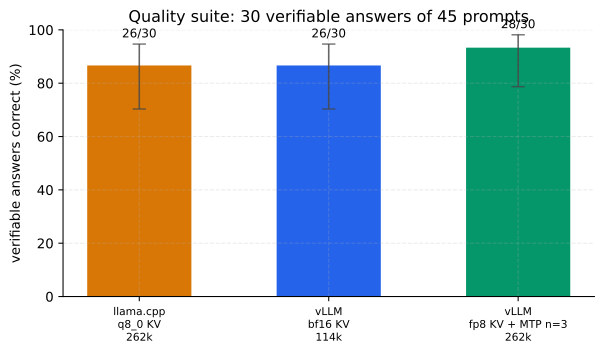
The bars look ordered, the ordering is not real: with n=30 the Wilson 95% intervals
are roughly 70–95% (26/30) and 79–98% (28/30) — they overlap almost completely. On
this suite we cannot distinguish the three configurations. The two answers that
separate fp8 from bf16 are one arithmetic slip (17.5% of 240: fp8 answered 42, the
others 36) and one reasoning chain that reached Friday instead of stopping at
Wednesday. Both are model behaviour, not KV precision.
Textually, the copies are near-identical:
- bf16 vs llama.cpp: mean similarity 0.993, 43 of 45 answers byte-identical
- bf16 vs fp8: 0.912, 38 of 45 identical
- fp8 vs llama.cpp: 0.916, 39 of 45 identical
The three prompts everybody failed are more interesting than the ones they got right:
'5' + '3' came back as 8 in all three (it treats it as arithmetic), “a sentence
about rain without the letter e” produced “Rain falls on the ground.” in all three
(there is an e in “the”), and the classic mislabelled-boxes puzzle was solved
correctly by everyone once given room to reason.
What this does not prove. Thirty prompts, one seed, no multi-turn, no tool
calling, no multilingual depth beyond a few translations. It is enough to say “we
found no quality cost from fp8 KV or q8_0 KV on this model”, not enough to say
“numerically equivalent”. Anyone who needs the latter should run MMLU-style evals at
scale — the harness in scripts/quality_eval.py is shaped for exactly that.
Part 6 — Where the time goes: TTFT, prefill, decode, concurrency
Every point below comes from the same protocol: one filler document, a needle at the very end, a 40-token answer, thinking off, and a unique nonce prefix so no prompt can hit a cache (see Part 7 — this matters more than it sounds).
| prompt tokens | llama.cpp q8_0 | vLLM bf16 | vLLM fp8 + MTP n=3 |
|---|---|---|---|
| ~5k | 4.0 s · 1248 t/s | 4.1 s · 1225 t/s | 4.1 s · 1219 t/s |
| ~40k | 39.0 s · 1026 t/s | 36.7 s · 1089 t/s | 40.1 s · 998 t/s |
| ~110k | 140.5 s · 783 t/s | 129.7 s · 848 t/s | 142.1 s · 774 t/s |
| ~200k | 347.1 s · 576 t/s | — (114k ceiling) | 330.1 s · 606 t/s |
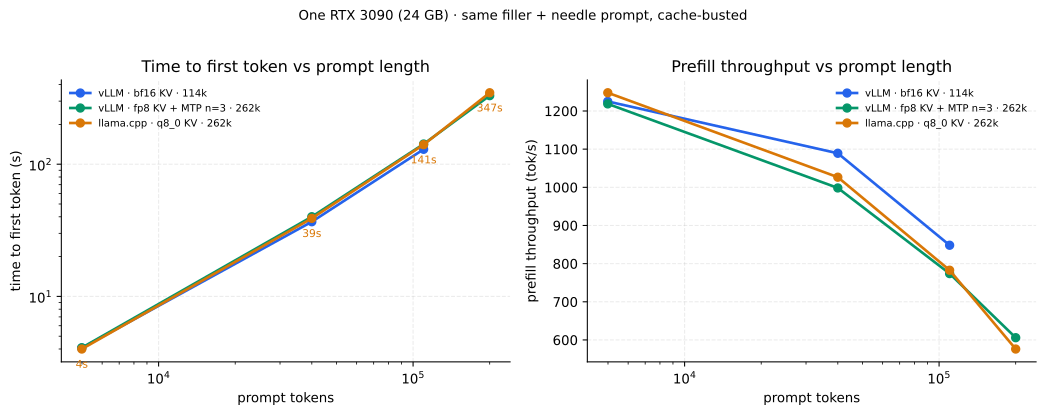
Prefill starts around 1.2k tokens/s for all three and decays to ~600 tokens/s at 200k tokens — the attention term, not the KV dtype, is what costs you at depth. What fp8 buys is not speed at a given length; it is reaching the length at all.
Decode is where the configurations genuinely separate:
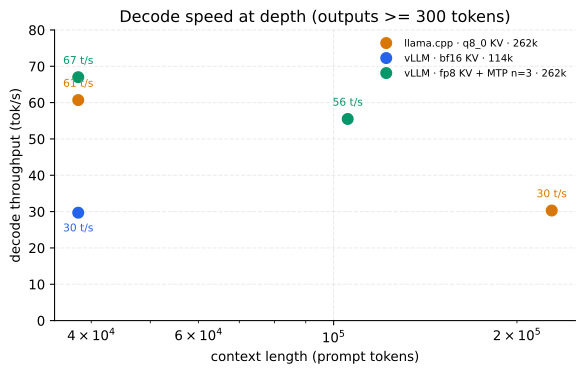
At 38k, bf16 KV decodes at 29.7 t/s while fp8 KV does 67.0 t/s on the same card with the same weights — same effect that makes llama.cpp’s q8_0 KV fast: half the bytes read per token. llama.cpp sits at 60.7 t/s at 38k and falls to 30.3 t/s at 228k.
Concurrency is where vLLM earns its complexity:
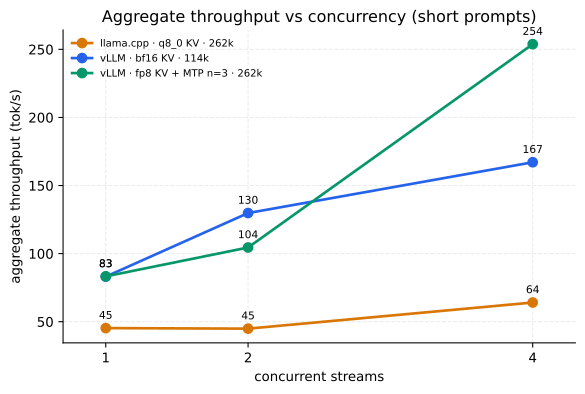
llama.cpp barely scales (45.3 → 64.1 t/s) because it processes slots the old way; vLLM bf16 reaches 167 t/s at four streams, and fp8 + MTP n=3 reaches 253.8 t/s — about 3× the single-stream rate. If you are serving several clients, that difference is the whole argument for vLLM.
Part 7 — Measurement traps (the ones that nearly fooled us)
These are not footnotes. Three of them produced numbers that looked plausible and were simply wrong.
1. Prefix caching silently fakes your prefill numbers. Our first sweep reported
36,911 tokens/s at 40k. It was vLLM answering from the prefix cache in 1.1 s. Every
prompt now begins with a unique NONCE-<uuid> so no block can match. If you benchmark
vLLM without cache-busting, your long-context numbers are fiction.
2. Short outputs make speculation look faster than the GPU can go. A 40-token probe at 200k reported 291 tokens/s decode. With a 320-token output the same point measures 55.5 t/s. MTP finishes short answers in a couple of draft steps; the per-token rate is dominated by the first step. Measure decode with outputs of at least a few hundred tokens.
3. The first request after boot is not representative. The same 5k prompt measured 585 t/s cold and 1219 t/s once warm — graph capture and lazy init were still happening. We now send a throwaway request before measuring.
4. The KV pool size changes between boots. fp8 reported 262,144 tokens on one boot and 294,362 on the next (1.00× vs 1.12×); bf16 reported 128,392 and 144,982. Quoting a single number implies a precision the allocator does not have — we quote ranges.
5. Hidden thinking tokens count as completion tokens. With --reasoning-parser qwen3, a “32-token answer” was 9 visible tokens plus 23 that were stripped before
display. Non-streaming clients see a token count that does not match what they read.
6. The two engines disagree about the tokenizer endpoint. vLLM’s /tokenize
wants {"prompt": ...}, llama.cpp’s wants {"content": ...}; the wrong key returns an
empty list rather than an error, which is how we got a division by zero instead of a
measurement.
Pinned environment
Numbers like these are only reusable if the versions are pinned. This is the exact stack behind every measurement above:
- GPU: NVIDIA RTX 3090, 24,576 MiB, compute capability 8.6 (Ampere)
- Driver / CUDA: 595.58.03 / CUDA 13.2 (host), CUDA 13.0.2 (container)
- vLLM image:
fraserpricee/bonsai-vllm:20260918, digestsha256:a40d14f5eb218d80984d5009a61262668f9665f2f2946b84bd3c0102f1fc85e9, vLLM 0.25.1 - llama.cpp: build 10709, commit
9a9394a89, custom build including the Hadamard MTP fix (see Part 2), modelTernary-Bonsai-2-27B-PQ2_0-MTP-Q8_0.gguf - vLLM final flags:
--max-model-len 262144 --max-num-seqs 64 --gpu-memory-utilization 0.92 --kv-cache-dtype fp8_e4m3 --speculative-config '{"method":"mtp","num_speculative_tokens":3}' --compilation-config '{"cudagraph_capture_sizes":[1,2,4,8,16,32]}' - llama.cpp flags:
-c 262144 --parallel 2 --kv-unified -ctk q8_0 -ctv q8_0 --flash-attn on --spec-type draft-mtp --spec-draft-n-max 2
Copy the whole command, not part of it. The image’s entrypoint already bakes in
--speculative-config '{"method":"mtp","num_speculative_tokens":7}'— the depth that crashes under load. Anything you pass ondocker runis appended and wins (vLLM logsFound duplicate keysand takes the later value). Pass the full flag set above, or verify what is actually running: n=3 shows ~83 tok/s solo and a 294k-token KV pool, n=1 shows ~71, and n=7 crashes under four concurrent streams.
What we would do differently
- Measure quality before tuning speed. We spent two days on KV dtypes with no evidence about what they did to answers. The eval harness took an afternoon and would have framed every earlier decision.
- One harness, not five.
ab_kv_test.py,test_max_ctx.py,test_vllm_max.py,a2a_test.pyandload_sweep.pyall grew separately and disagreed about units.ttft_sweep.pyandquality_eval.pyreplace them. - Treat speculative-decoding depth as a first-class parameter. It caused the crash we blamed on fp8, and it distorts short-output benchmarks.
- Write down boot variance from day one. The KV pool number is not a constant.
- Log the config next to the number, always — half the confusion in our own notes came from tables whose flags were recorded three paragraphs away.
FAQ
Will this work on a 4090? Almost certainly the same shape — same 24 GB, same compute capability 8.9 — but we have not measured it, so we do not claim it. The KV math is identical; the bandwidth is higher, so decode should be faster.
And on an A6000 (48 GB)? Yes, and comfortably: 262k at bf16 KV is ~28.6 GiB, which fits with the weights on a 48 GB card without any KV quantization.
Why not just run a 70B? A 70B at 4-bit is ~40 GB of weights before any KV cache. On 24 GB it does not fit, at any context length.
Is fp8 KV actually safe? On this model and this image, under concurrency, with MTP at n=3: yes, measured, no degradation we could detect in 45 prompts. Keep bf16 if you want zero novelty in the stack and can live with 114k instead of 262k.
Which should I use for an agent backend? vLLM: OpenAI-compatible API, 3× throughput at four streams, spec decoding on. But be aware we did not test tool calling or multi-turn behaviour — that is the obvious next report.
Can I reproduce all of this? Yes: scripts/ has the harnesses, data/ has the raw
JSON from every run, and the pinned versions above are the ones that produced them.
Part 8 — What does 2-bit actually cost? Compared against the original
Everything above compares three ways of running the compressed model. It never answers the question a reader actually has: what would the original weights have done?
The answer is in the model’s own metadata — the GGUF declares
base_model = Qwen/Qwen3.8-27B. That model is served on OpenRouter, so it can be
measured with the same 45 prompts, with the provider pinned so routing cannot change
under us: DeepInfra for bf16, Chutes for fp8, both at 262k context. Total cost
of the whole matrix: $0.10, zero errors, provider verified in every response.
| weights | thinking off | thinking on |
|---|---|---|
| Qwen3.8-27B bf16 (DeepInfra) | 28/30 | 30/30 |
| Qwen3.8-27B fp8 (Chutes) | 28/30 | 30/30 |
| Ternary 2-bit, local, fp8 KV | 28/30 | 30/30 |
| Ternary 2-bit, local, bf16 KV | 26/30 | 30/30 |
| Ternary 2-bit, llama.cpp q8_0 | 26/30 | 30/30 |
Two findings, and they point in opposite directions from what we assumed.
First, the compression is invisible on this suite. The 7.1 GB ternary build scores exactly what the bf16 original scores — at both thinking settings. Whatever the 2-bit weights cost, it is not measurable in 30 verifiable answers.
Second, thinking mode is the entire difference — every configuration reaches 30/30 with it on: the bf16 original, the fp8 original, and all three local variants (fp8 KV, bf16 KV, llama.cpp q8_0). Not one of the five loses a verifiable answer.
It is also not free. Completion tokens over the whole suite:
| configuration | thinking off | thinking on | factor |
|---|---|---|---|
| local fp8 KV | 1,510 | 5,936 | 3.9× |
| local bf16 KV | 1,254 | 5,961 | 4.8× |
| llama.cpp q8_0 | 1,293 | 5,579 | 4.3× |
So the honest framing is not “the ternary model is worse” but “thinking costs ~4× the output tokens and buys the last 2–4 answers”, and that price is identical for the compressed model and for the original. At 262k context, 4× the decode work is the actual reason to leave it off — not accuracy.
The four disagreements, all of them, when both run without thinking:
(47 × 13) − (96 / 4)— original answered 605 (wrong); ternary wrote out611 − 24 = 587and got it right- 80 € −25% +21% — original answered 63.00 (wrong); ternary showed
60 × 1.21and got 72.60 print('5' + '3')— original answered 53 (right); ternary answered 8- “a sentence about rain without the letter e” — original wrote “Rain falls on dry soil.” (right); ternary wrote “Rain falls on the ground.”
Net zero. The pattern is not “compressed model is dumber” — it is “without thinking, the original takes shortcuts and slips on arithmetic, while the ternary build writes its work out and slips on strict string constraints instead”.
A last asymmetry worth knowing: llama.cpp returns the reasoning in a separate
reasoning_content field for all 45 prompts; both vLLM configurations return it empty
for all 45, so the chain is generated and thrown away. Same answers, different
observability — if you want to audit how the model reaches an answer, that is an
argument for llama.cpp that has nothing to do with speed.
Serving precision is a wash too. bf16 and fp8 versions of the original agree on 0.937 of answer text (38/45 byte-identical) with identical scores, so nothing observed here is attributable to fp8.
Long context, checked against the original rather than self-reported. Same needle at the end of the document, Chutes fp8, provider-pinned:
| prompt tokens | wall time | needle recovered |
|---|---|---|
| 20,526 | 3.7 s | ✅ |
| 102,587 | 13.9 s | ✅ |
| 205,164 | 34.2 s | ✅ |
Those wall times are a warm datacenter GPU and are not comparable to the 330 s this card needs at 200k — they only establish that the original behaves normally at depth, so the 262k window is not a ternary trick.
Three caveats worth as much as the result. (1) With thinking enabled, vLLM’s
reasoning_content came back empty on every prompt — the chain is generated and
discarded — so on that engine we score the answer but cannot inspect the reasoning
(llama.cpp keeps it, all 45 prompts). (2) n=30, one seed: this detects a
large regression, not a 3% one. (3) The original was measured on third-party providers
we can verify by name but cannot audit.
Decision guide
- Maximum context, both engines now reach it → vLLM final config (262k + batching) or llama.cpp (262k, 1 GB less VRAM, faster long-context decode).
- Long documents, single user → llama.cpp still wins decode at depth (60.7 vs 29.7 tok/s at 38k, bf16-KV vLLM measurement; the fp8 config has not been re-measured there).
- Several users / chat UI / batching → vLLM final config (253.8 tok/s agg at 4 streams).
- Short-context throughput → either; they are within 1% of each other.
- Do not use fp8 KV with
num_speculative_tokens: 7on Ampere, and skip turboquant presets until the upstream fix lands.
Reproduce it
scripts/ab_kv_test.py— bf16 vs fp8 KV A/B (outputs + TTFT + t/s + load test)scripts/test_vllm_max.py— vLLM max-context needle + concurrencyscripts/test_max_ctx.py— llama.cpp max-context needle (228k depth)scripts/a2a_test.py— apples-to-apples harness (vllm|llama)scripts/load_sweep.py— x2/x4 short-prompt concurrency sweep (load_sweep.py <label> 2,4)scripts/long_conc.py— N simultaneous long prompts with a per-stream needle (long_conc.py <label> <n> <tokens>) — this is the run that proves real multi-session capacity, not just a short-prompt load testscripts/sweep_seqs.sh— boot-only sweep of--max-num-seqs/--max-num-batched-tokens(both turned out not to change the KV pool on this model)data/— raw JSON results,RESULTS.mdlab notebook, launch scriptTIMELINE.md— the day-by-day path, including the ruled-out hypotheses
Credits
This work builds entirely on other people’s work; full attribution with links is in
CREDITS.md. In short:
- Model: Ternary-Bonsai-2-27B by Prism ML — ternary (~2-bit) weights, based on the Qwen3.8-27B architecture from the Qwen team (Alibaba). The BF16 MTP head used for speculative decoding comes from the same Qwen3.8-27B release; every drafted token is verified by Bonsai.
- vLLM path: the
prism_ternaryplugin, custom CUDA kernels, model converter and docker image are by fraserprice (fraserprice/bonsai-vllm, unofficial and WIP, not affiliated with Prism ML), built on vLLM and its FlashInfer attention backend. - llama.cpp path: ggml-org/llama.cpp —
llama-server, KV-cache quantization and MTP speculative decoding; GGUF packaging credited to ProCreations as noted in the launch script. - Measurement: dependency-free Python stdlib harnesses, Docker + NVIDIA Container Toolkit, Hugging Face Hub for weights and caching.
- Hardware: RTX 3090 (24 GB, sm_86) — all numbers in this report were measured there, not on the Blackwell card the upstream image was validated on.
If you reuse this material, keep these credits and link back to the authors. Bugs in
the vLLM plugin belong upstream in fraserprice/bonsai-vllm.
About the author: I build SmartPhotoCropper — an on-device AI photo cropper that runs in the browser — and this is the kind of local-inference work I do on the same machine. Model by Prism ML; vLLM repack and kernels by fraserprice; llama.cpp by ggml-org. Raw runs and harnesses: companion repo.